
Paresh Rawal has robustly defended Prime Minister Narendra Modi, dismissing claims of divisive politics and asserting that Modi 'never does Hindu-Muslim politics.

The Press Club of India clarified it did not organise an event where Prime Minister Narendra Modi's cutout was worshipped and a 'Modi Chalisa' was read. The event, organised by the Bihar State Transgender Welfare Board, was stopped by club authorities due to violation of rental terms. The organiser plans to build a temple for PM Modi in Bihar, citing his support for the transgender community.

Prime Minister Narendra Modi has announced plans to modernise India's civil defence volunteer force, stating that the existing system, designed for conventional wars, is inadequate against contemporary threats targeting critical infrastructure like refineries, banks, and data centres.

Dharmendra Pradhan's resignation is significant because it punctures, however slightly, the perception that the Modi government never retreats under pressure. Every long-serving government eventually reaches a point where every institutional failure is identified with the leader himself. Removing the minister may have prevented that political burden from falling directly on Modi. Whether it also resolves the underlying crisis is another matter, notes Ramesh Menon.

As Sonam Wangchuk's hunger strike enters its 19th day, critics question why the government has remained silent despite mounting concerns over student welfare, observes Harishchandra.

US Vice-President J D Vance's unexpected phone call to Prime Minister Narendra Modi on August 8 has ignited speculation about a potential diplomatic overture, possibly seeking India's support amidst the escalating US-Iran conflict and a shifting global power landscape, suggests Ambassador M K Bhadrakumar.

Prime Minister Narendra Modi's 'dimagi Naxal' (intellectual Naxal) remark, made during his Independence Day address, has ignited a significant political debate, with Union Minister Kiren Rijiju clarifying that the comment targets those who support Maoists and separatists, not opposition leaders, while opposition figures like P Chidambaram have embraced the label in defiance.

It was left to an incensed Gen Z to show the rest of India that enough was enough, and that the time had come to shatter the fear psychosis generated by the government's authoritarian approach to protests and criticism, points out M R Narayan Swamy.

A delegation of NCP (SP) Lok Sabha MPs, led by Supriya Sule, met Prime Minister Narendra Modi to discuss various issues concerning Maharashtra, including drought, onion prices, and river pollution. The meeting, which lasted about 15 minutes, did not include discussions on the FCRA Amendments Bill, which Sule opposes. This follows a previous meeting between Sharad Pawar, Sule, and the PM regarding student and farmer issues.

India's IT Secretary S Krishnan announced an upcoming meeting with Meta's global team to address critical issues including lapses in tackling Child Sexual Abuse Material (CSAM), the temporary restriction of PM Modi's Facebook post, and concerns over synthetically generated information. The government expects Meta, as a leading tech company, to have robust systems to manage these challenges effectively.

Hyderabad-based Midwest Ltd has become the first Indian private company to secure overseas critical mineral mines, sealing a deal with Indonesia's state-run PT Perusahaan Mineral Nasional (PERMINAS) to ensure a long-term supply of rare earths.

Congress leader Priyanka Gandhi criticised Prime Minister Narendra Modi, stating he needs to change his "dil ka angle" (heart's perspective) rather than camera angles to connect with Gen Z, following his Instagram outreach to student protesters. She also condemned the government's handling of student protests and the widespread issue of paper leaks.

Opposition leaders have sharply criticised Prime Minister Narendra Modi's appeal to 'forgive' young protesters who used abusive language, accusing him of deflecting from issues of alleged police action and a 'broken education system'.

Prime Minister Narendra Modi, in his 80th Independence Day address, expressed strong confidence that India will achieve developed nation status by 2047, urging citizens to embrace big dreams and unwavering resolve to realise 'Viksit Bharat'. He highlighted India's economic transformation and significant growth in various sectors, including defence production, electronic manufacturing, and mobile phone production.

Congress leader Rahul Gandhi launched a scathing attack on the BJP-RSS, labelling them a "bunch of jokers" with no understanding of India, and criticised Prime Minister Narendra Modi's foreign policy as merely "hugging leaders." He also claimed the RSS has become an instrument of large capital, serving Adani and Ambani, and vowed that the Congress would keep pressure on the government until Modi and Shah resign. The BJP hit back, calling Gandhi immature and out of depth.

Prime Minister Narendra Modi extended birthday wishes to Union Education Minister Dharmendra Pradhan, commending his significant contributions to the implementation of the National Education Policy. This praise follows the successful re-examination of NEET-UG, despite earlier controversies surrounding paper leaks.

The Indian government has summoned Meta's global head of public policy after Prime Minister Narendra Modi's Facebook post, addressing youth and promising action against paper leaks, was temporarily removed. Meta attributed the removal to a 'glitch' in its automated content filters, an explanation the government deems insufficient, demanding further discussions.

Nationalist Citizens Party of India leader Abu Taher attended a breakfast meeting hosted by Prime Minister Narendra Modi for NDA allies but asserted that his party is not part of the ruling alliance. He stated his attendance was solely to raise public issues directly with the Prime Minister.

Opposition parties have criticised the AAP government in Punjab following twin blasts in Jalandhar and Amritsar, citing a breakdown in law and order and intelligence systems. The blasts have sparked a political blame game, with accusations flying between the AAP and BJP.

Prime Minister Narendra Modi has highlighted the risks posed by the 'weaponisation' of resources and strategic sea routes, urging India to achieve greater self-reliance in energy to mitigate vulnerabilities to overseas supplies and geopolitical tensions.

Rahul Gandhi's aggressive street politics is giving him a fresh political edge, but overplaying his role could hurt his credibility with the wider opposition, predicts M R Narayan Swamy.

Economists highlight that resolving domestic policy bottlenecks, particularly through land reforms and improving the ease of doing business, will be critical for Prime Minister Narendra Modi's 'next-generation reforms' and India's economic transformation towards its 'Viksit Bharat' vision for 2047.

The US Commission on International Religious Freedom (USCIRF) has recommended sanctions against the Rashtriya Swayamsevak Sangh (RSS) and advised the US government against extending diplomatic courtesies to its leaders. This comes ahead of RSS Chief Mohan Bhagwat's visit to the US, with USCIRF officials citing allegations of attacks on religious minorities by RSS sub-groups. India has consistently rejected USCIRF's reports as biased and selective.
Prime Minister Narendra Modi, in his Independence Day address, highlighted technology and innovation as central to India's goal of becoming a developed nation by 2047. He called for India to lead in emerging technologies like AI, quantum computing, and space, announcing a massive AI skilling initiative for one crore youth. Modi stressed the importance of becoming a global innovation hub, bolstering energy security with nuclear power, and strengthening cybersecurity.

Congress leader Rahul Gandhi has strongly criticised the Indian government's temporary restriction on Telegram ahead of the NEET-UG re-examination, calling it a 'new trick' that punishes students instead of tackling the root cause of paper leaks. He highlighted the suicides of two students, Umesh and Riya, linking their deaths to the 'broken, corrupt system' and the government's alleged failure to protect students from exam mismanagement.

Notwithstanding the economic complementarities and the host of agreements for deepening economic relation on a host of areas, both sides share common viewpoints on the foreign policy domain and seek common grounds to serve as a counterweight to China, notes Dr Rajaram Panda.

The National Testing Agency (NTA) is reviewing its internal processes and protocols following lapses in three papers of the UGC-NET June 2026 examination, leading to re-tests for English, Commerce, and Sociology. The agency stated it proactively identified issues and is taking corrective measures to ensure fair and error-free examinations, amidst strong criticism from opposition leaders.

Prime Minister Narendra Modi will review the impact of the West Asia conflict on India's food, energy, and fuel security with senior cabinet ministers. The meeting follows previous discussions and concerns raised about global energy crises and supply chain disruptions.

National Security Advisor Ajit Doval is in Beijing for the 25th round of Special Representatives talks on the India-China boundary issue with his Chinese counterpart Wang Yi. These crucial discussions precede Chinese President Xi Jinping's anticipated visit to India for the BRICS summit, offering a potential opportunity for a meeting with Prime Minister Narendra Modi. The talks aim to address the long-standing border dispute and recurring tensions, with both sides emphasising the importance of peace and tranquillity for bilateral relations amidst recent reports of aggressive Chinese posturing in Arunachal Pradesh.

Russia on Monday assured India of uninterrupted supply of energy and fertilisers amid disruption caused by the West Asia crisis, as External Affairs Minister S Jaishankar met President Vladimir Putin in Moscow and held talks with his key interlocutors.

Opposition leaders across party lines have condemned the forced removal of climate activist Sonam Wangchuk from the Jantar Mantar protest site in Delhi, accusing the BJP-led central government of undermining democratic freedoms, curbing dissent, and choosing force over dialogue.

Congress leader Rahul Gandhi urged girl students to "smash patriarchy" and criticised the "Manusmriti mindset" during an interaction in Pune, highlighting issues of sexual harassment, safety, and economic independence for women.
National security advisor Ajit Doval arrived in Beijing on Monday for a two-day visit to take part in the Special Representatives talks on the India-China boundary question with his Chinese counterpart and Foreign Minister Wang Yi.

Congress leader Rahul Gandhi has intensified his criticism of the government, demanding the immediate removal of Education Minister Dharmendra Pradhan and an apology from Prime Minister Narendra Modi following alleged pellet gun injuries to student protesters.

Former Union Education Minister Dharmendra Pradhan stated that attempts were made to "mislead" Gen Z during the NEET paper leak protests, prompting his resignation, and also addressed criticism from former Odisha CM Naveen Patnaik.
The Congress party is set to challenge the Modi government on a range of critical issues, including alleged theft of Ram temple donations, 'systemic corrosion' of the education system, and constitutional amendment bills related to delimitation and dismissal of ministers, during the upcoming Monsoon Session of Parliament.
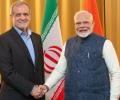
Prime Minister Narendra Modi held a telephonic conversation with Iranian President Masoud Pezeshkian, discussing recent developments in West Asia and reiterating India's emphasis on the importance of freedom of navigation in the Strait of Hormuz. Modi welcomed the recent peace understanding between the US and Iran, stressing dialogue and diplomacy for regional stability. India will also send representatives to the burial ceremonies of Iran's late Supreme Leader.

Prime Minister Narendra Modi criticised the Mamata Banerjee government in West Bengal, citing misrule and corruption, and urged voters to elect the BJP for development and progress.

Prime Minister Narendra Modi announced six guarantees for West Bengal if the BJP wins the Assembly polls, promising to end the 'reign of fear' and address corruption, while criticising the TMC government's performance.

History may remember Takaichi Sanae not as the leader who simply accelerated Japanese rearmament, but as one who governed during Japan's transition from an industrial-age security model to a post-industrial strategic member of the global order, points out Varun Arya.
